On June 2, the All-Russian Museum of Decorative Art launched the exhibition ‘Vera Mukhina: Dialogues, Facets’. This large-scale project presents a fresh perspective on Mukhina’s legacy, showcasing her not only as the creator of the iconic ‘Worker and Collective Farm Woman’ but also as an international innovator, researcher, and bold experimenter in glass art, architecture, and monumental sculpture.
‘It is gratifying to see how much the familiar platform of the Museum of Decorative Art has transformed recently. The museum has confidently entered a new phase of development, with numerous impressive projects held here lately. The exhibition ‘Vera Mukhina: Dialogues, Facets’, which we open today, is one such project. It reveals a completely different, unfamiliar Mukhina, showcasing her talent from a new angle and telling about lesser-known but equally significant parts of her great legacy. I am confident this exhibition will become one of the highlights of this summer season,’ said Ivan Lykoshin, Director of the Department of Museums and Circus Art Support at the Ministry of Culture of the Russian Federation.
The exposition brings together works from over 30 state and private collections, including those from the Museum of Decorative Art, the Pushkin State Museum of Fine Arts, the Tretyakov Gallery, the Russian Museum, the Shchusev Museum of Architecture, and other leading institutions. Some items are on display in Moscow for the first time. The exhibits span nearly half a century of Vera Mukhina’s creative journey—from her apprenticeship in Paris in the early 1910s and visits to glass workshops in Italy and France to the creation of an experimental art glass laboratory in Leningrad. Rare documentary footage of Mukhina working at a glass factory and multimedia installations complement the display.
‘Our museum holds one of the largest collections of decorative art in Russia—and it is here that Mukhina’s legacy finds its true context. This exhibition is not a retrospective or a monument. It is a story of how an artist’s courage, talent, and passion give birth to art that surpasses its time. Mukhina took a risk—and opened an entire era,’ said Tatiana Rybkina, Director of the All-Russian Museum of Decorative Art.
The exhibited items reveal Mukhina’s multifaceted and interdisciplinary activity, which marked an important stage in the development of Russian sculpture and decorative applied arts. She unlocked new possibilities of glass by synthesizing experience gained from European masters and the technological potential of the Soviet school. Her creative and pedagogical work formed a strong continuity that spurred the growth of domestic glassmaking, according to the exhibition curator.
Among the key exhibits is ‘Wind’ (1957), a glass sculpture embodying the central motif of Mukhina’s work: the same impulse captured in ‘Worker and Collective Farm Woman’. Additionally, visitors will see a glass bust, ‘Comrade from Trade Unions’, likely a portrait of renowned African American poet Claude McKay. Created by Mukhina in 1939 and displayed at the New York World’s Fair, the bust was purchased at an auction in the USA and returns to Russia for the first time; it has never been exhibited in Russia before. The exhibition also highlights other international triumphs of Mukhina, such as those at exhibitions in Paris and Venice.
A central section is dedicated to the period associated with the experimental art glass workshop, later the Leningrad Glass Factory. Under Mukhina’s leadership and with the participation of chemist Nikolai Kachalov, innovative glass compositions stronger than marble were developed. This is when the famous columns for Avtovo metro station, recognized as one of the world’s most beautiful, were created. Architectural details of these columns can be seen in the exhibition.
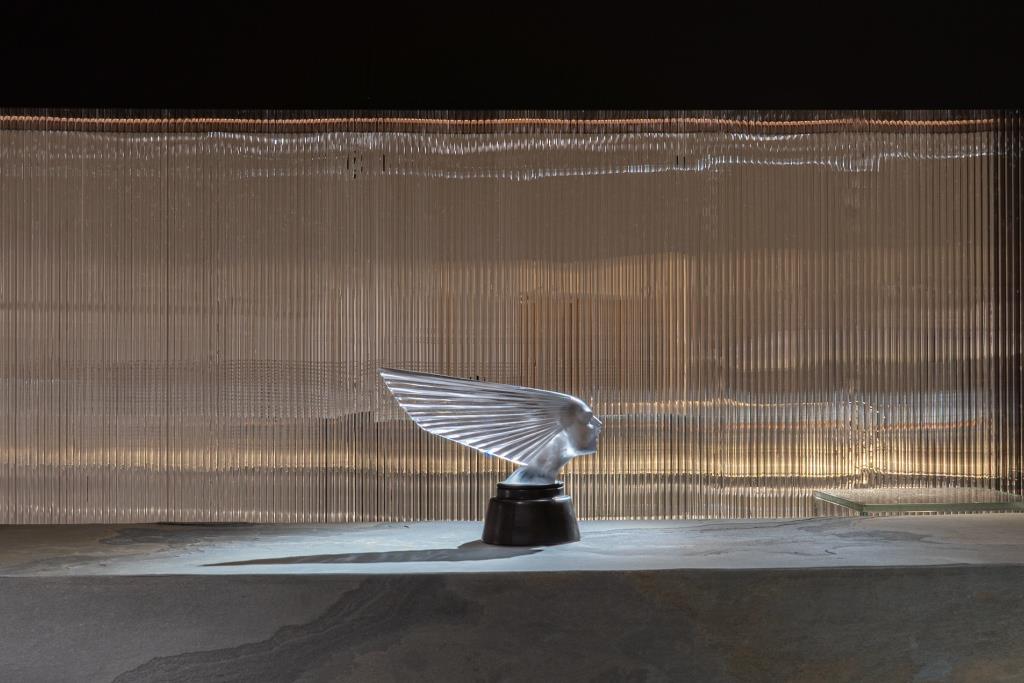
Special attention is given to the formation of Mukhina’s artistic language, influenced by visits to exhibitions and art workshops in France and Italy. On display is a work by Mukhina’s teacher, Antoine Bourdelle—‘Resting Sculptress’ from the early 20th century, representing a collective image of a woman-creator, embodied by Vera Ignatievna herself. It was from Bourdelle, a student of Rodin, that Mukhina inherited her passion for ancient culture. Visitors will see allegorical references to antique themes and clear quotations of ancient monuments in well-known works. Creative dialogues with French masters René Lalique and Marius Sabino, whose crystal fountains and Art Deco forms later found new interpretations in Mukhina’s work within the context of Soviet monumental and decorative art, are also of great interest.
The exhibition concludes with a section titled ‘Our Contemporary’, featuring works by modern glass artists that engage in dialogue with Mukhina’s legacy. A special project, ‘Moscow of Mukhina’, a map guide to places associated with the great sculptor, created in collaboration with VDNKh, accompanies the exhibition.
The exhibition is open until September 27.